Daylight is vital and has a significant influence on our health and wellbeing. It controls our biorhythm, our hormone balance, our mood and our sleep. We often only realise how important daylight really is to us when we lack it. If we receive too little natural light and sunlight, the risk of health problems and mood disorders increases.
Not only is daylight essential for humans, but the animal and plant world also needs light. It is the energy source for all organisms. Without light, for example, plants could not photosynthesise and produce oxygen. Animals would not be able to develop a stable day-night rhythm without the natural change of daylight and darkness. Without sunlight and natural daylight, no life on earth would be possible.
Table of Contents
If we receive too little daylight, it has a significant influence on the balance of the body's own hormones melatonin and serotonin.
Melatonin is referred to as the sleep hormone and significantly influences the quality of our sleep. The pineal gland releases the hormone mainly in darkness. The longer it is dark, the more melatonin is produced. Serotonin is known as the happiness hormone, makes us awake and positively influences our mood. However, the two hormones are by no means only antagonists, as they are closely interdependent. In the pineal gland, melatonin is largely formed from serotonin.
If our body receives too little light, the hormone balance between melatonin and serotonin is disturbed. Sleep disorders, daytime fatigue, lack of energy and drive, and even seasonally dependent depressions can be the result. Especially on dark days and when little natural daylight and sunlight is available for our body, this inner balance quickly becomes unstable and our general wellbeing is negatively affected.
The seasons also have an influence on the production of melatonin and serotonin. During the autumn and winter months, when the days are shorter and we receive less daylight, more melatonin circulates in our blood. On bright, sunny days in spring and summer, serotonin production is automatically boosted and we feel fitter and more vital.
In times when there was neither electric light nor an alarm clock, people lived according to the dictates of nature. They went to bed when it got dark and got up when the sun rose. This is how our internal clock has been ticking since time immemorial.
The main pacemaker of this internal clock is light - more precisely, the appropriate interplay of daylight and darkness. If we receive sufficient daylight during a stable light-dark cycle, this has a positive effect on our internal clock, our biorhythm. The reason for this are ganglion cells in the retina of the eye. They are light-sensitive and regulate biological processes in the body, such as our internal clock, when light falls.
Ideally, our sleep-wake rhythm is designed to allow us optimum sleep and regeneration during darkness and optimum performance during brightness. If we receive too little light, our internal clock quickly becomes unbalanced. Health problems, sleep disorders and a generally reduced sense of wellbeing can be the result.
On short and often dark days in autumn and winter, we occasionally feel listless and tired. The reason for this is often a lack of natural daylight and sunlight. The signs of light deficiency are varied and are often referred to as winter depression or light deficiency depression.
Typical symptoms and consequences of daylight deficiency are:
A lack of light can affect each of us. In the past, most tasks consisted of physical work that took place outdoors. Today, the majority of us work in enclosed spaces. In addition, there are working time models such as night and shift work.
Even in the home office, we tend to retreat into our own four walls and rarely venture outside into the daylight. As a result, there can also be an increased occurrence of light deficiency symptoms here.
In addition, the seasons have a great influence on the amount of daylight available to us. Especially in autumn and winter, it gets light late in the morning and dark early in the evening. Even the days can often remain dull. The light intensity outdoors is significantly lower than in the summer months, which can further exacerbate the lack of light.
Even half an hour of daylight and sunlight per day can, according to scientific knowledge, make a valuable contribution to our health and wellbeing. For example, according to Anna Wirz-Justice, neurobiologist and professor at the University Hospital Basel, about 30 minutes of daylight is sufficient to synchronise our internal clock.
There are significant differences between daylight and artificial light. The most important here are light intensity and colour spectrum. The full colour spectrum of light, for example, is only found in daylight and sunlight. The light intensity of natural light is also much higher than that of artificial light sources. On a beautiful summer day, for example, the light intensity outdoors is up to 100,000 lux. For comparison: In a well-lit office, the illuminance is only around 500 lux.
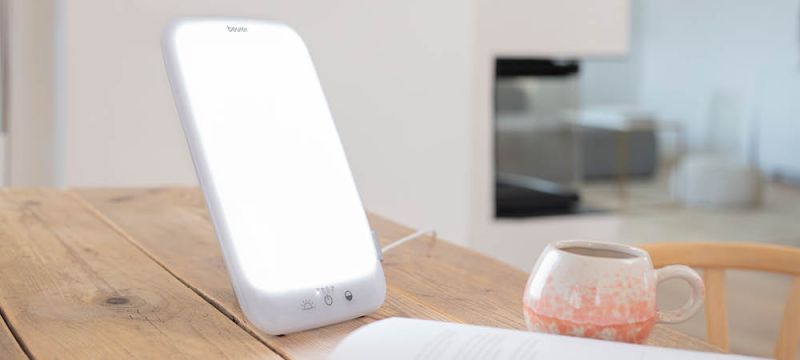
Nevertheless, special daylight therapy lamps are very good at simulating natural light, which is why they have a similarly positive effect on our body as daylight. That's why they are also called "sun lamps", as they can produce natural daylight. Whether a lamp has a medical effect depends mainly on two factors: the illuminance and the colour temperature.
The illuminance of a lamp corresponds to its brightness and is measured in the unit lux. To achieve a therapeutic effect, an illuminance of at least 2,500 lux is recommended. The colour temperature of the lamp is the light heat and is given in Kelvin. The higher the number of Kelvin, the "colder" and whiter the light. At the same time, electric light has an increased red component compared to daylight. Due to the low lux value and the increased red component, conventional electric light sources are therefore not sufficient to have a medical effect.
Daylight therapy lamps can simulate daylight of 10,000 lux and produce a very bright light. The colour temperature of the light boxes is between 5,300 and 6,500 Kelvin, which corresponds approximately to the characteristic colour temperature of daylight. Thanks to the light intensity of 10,000 lux and the colour temperature in the blue range, our daylight therapy lamps are very good at imitating natural light.
Whether you are already suffering from symptoms of light deficiency or you simply don't want to give the winter blues a chance. Our tips can be easily and conveniently integrated into your everyday life and provide you with optimal daylight even in times of low light.
With Beurer daylight therapy lamps, you can easily bring the sun into your home. Our daylight therapy lamps have a lighting intensity of 10,000 lux and cover the colour spectrum of daylight very well. As a result, they have a similarly positive effect on our bodies as natural daylight and are perfect for effective light therapy. They help you prevent light deficiency symptoms and compensate for the effects of light deficiency. The production of serotonin is stimulated, our internal clock is reset, and we feel fitter, more vital and balanced.
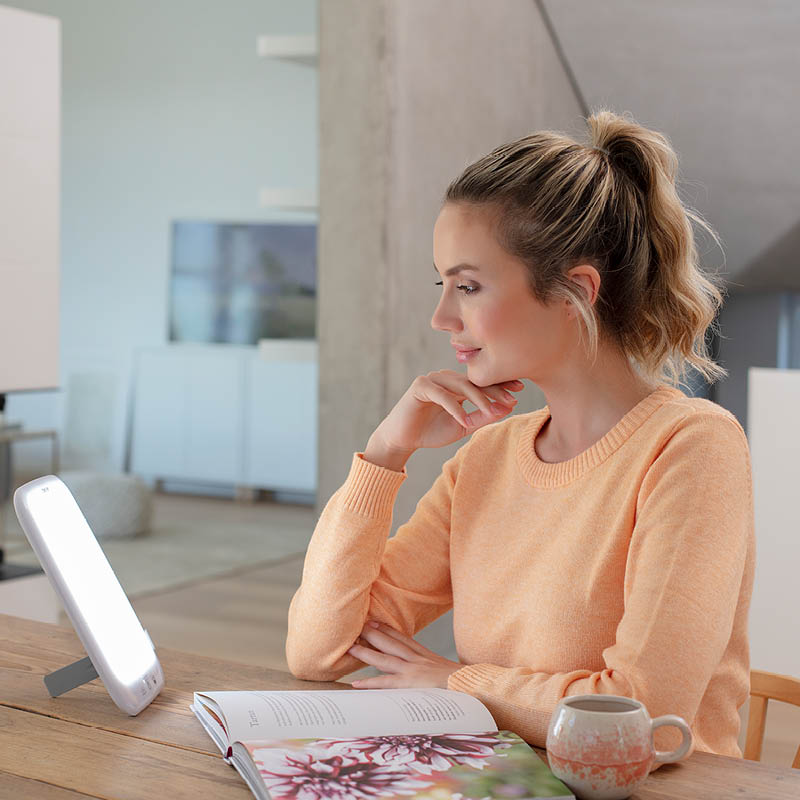
The effectiveness of light therapy is scientifically proven. In the guideline "Unipolar Depression" of the German Society for Psychiatry, Psychotherapy and Neurology, light therapy is one of the treatment options "first choice for seasonal dependent depression" (winter depression)*1. Would you like to learn more about light treatment with daylight therapy lamps? Then take a look here. Give it a try and treat yourself to an extra dose of light and vitality for your everyday life with our sun lamps.
Especially when it's cold and wet outside, it often takes more effort to go out for a round in the open air. But even though the light intensity in autumn and winter is lower than in summer, your body benefits from natural daylight. The happiness hormone serotonin is released, which lifts the mood and counteracts depressive moods.
Spending more time outdoors is not that hard and can easily be integrated into your everyday life with small behavioural changes. Leave the car behind and walk or cycle. This way, you're not only doing something good for your well-being, but also for the environment.

If you find walking alone boring: arrange to go for a walk with friends and family or listen to your favourite music or an exciting podcast. Coffee or tea can also be enjoyed "to go" outdoors.
Even at work in the office or home office, you can consciously choose workplaces with plenty of daylight. Bright spots by the window provide you with more natural daylight even in indoor spaces. However, the light intensity outdoors is much higher than in enclosed spaces, even on cloudy days. Therefore, a bright workspace cannot replace going outdoors.
Good to know: More and more companies are designing the perfect workspace with optimal light. This involves using changing colour temperatures and light intensity (Human Centric Lighting). The concept of Human Centric Lighting puts people and their perception of light at the centre.

In the office, for example, the ideal lighting system changes the colour temperature throughout the day to accompany employees in high concentration or relaxation phases. This increases the motivation and productivity of employees and reduces work accidents and absences.
If you leave the house in the dark in the morning and don't get back until late in the evening, you sometimes have little opportunity to provide your body with enough daylight. It helps to consciously spend your lunch break outdoors.
And because it usually tastes even better in the fresh air and in company: why not arrange to have a joint lunch snack with a nice colleague and use the lunch break to soak up some daylight.

*1 https://www.leitlinien.de/themen/depression/archiv/pdf/depression-2aufl-vers1-kurz.pdf
Beurer Healthguide
This advice page was made by Beurer GmbH and is intended to help you feel healthy and happy all round.
The content of the Healthguide is intended to provide assistance and information and can in no way replace the advice of a doctor.
Questions
If you have any questions or suggestions about our advice page, you can contact us at any time.